A cigar is a rolled bundle of dried and fermented tobacco leaves made to be smoked. Cigars are produced in a variety of sizes and shapes. Since the 20th century, almost all cigars are made of three distinct components: the filler, the binder leaf which holds the filler together, and a wrapper leaf, which is often the highest quality leaf used. Often there will be a cigar band printed with the cigar manufacturer's logo. Modern cigars often come with two bands, especially Cuban cigar bands, showing Limited Edition (Edición Limitada) bands displaying the year of production.
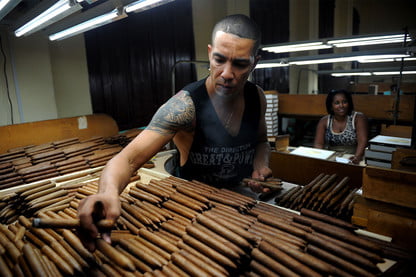
Cigar tobacco is grown in significant quantities primarily in Central America and the islands of the Caribbean, including Cuba, the Dominican Republic, Haiti, Honduras, Mexico, Ecuador, Nicaragua, Guatemala, Costa Rica, Panama, and Puerto Rico; it is also produced in the Eastern United States, Brazil and in the Mediterranean countries of Italy and Spain (in the Canary Islands), and in Indonesia and the Philippines of Southeast Asia.
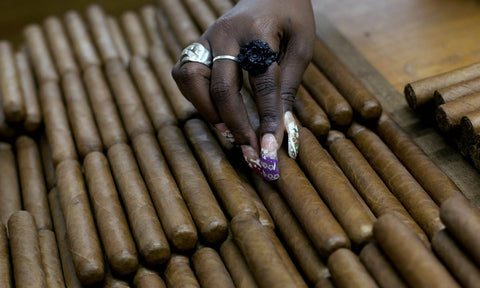
Tobacco leaves are harvested and aged using a curing process that combines heat and shade to reduce sugar and water content without causing the larger leaves to rot. This takes between 25 and 45 days, depending upon climatic conditions and the nature of sheds used to store harvested tobacco. Curing varies by type of tobacco and desired leaf color. A slow fermentation follows, where temperature and humidity are controlled to enhance flavor, aroma, and burning characteristics while forestalling rot or disintegration.The leaf will continue to be baled, inspected, un-baled, re-inspected, and baled again during the aging cycle. When it has matured to manufacturer's specifications it is sorted for appearance and overall quality, and used as filler or wrapper accordingly. During this process, leaves are continually moistened to prevent damage.
Quality cigars are still handmade.An experienced cigar-roller can produce hundreds of good, nearly identical cigars per day. The rollers keep the tobacco moist—especially the wrapper—and use specially designed crescent-shaped knives, called chavetas, to form the filler and wrapper leaves quickly and accurately.Once rolled, the cigars are stored in wooden forms as they dry, in which their uncapped ends are cut to a uniform size.From this stage, the cigar is a complete product that can be "laid down" and aged for decades if kept as close to 21 °C (70 °F) and 70% relative humidity as possible. Once purchased, proper storage is typically in a specialized cedar-lined wooden humidor.
Long filler cigars are a far higher quality of cigar, using long leaves throughout. These cigars also use a third variety of tobacco leaf, called a "binder", between the filler and the outer wrapper. This permits the makers to use more delicate and attractive leaves as a wrapper. These high-quality cigars almost always blend varieties of tobacco. Even Cuban long-filler cigars will combine tobaccos from different parts of the island to incorporate several different flavors.
In low-grade and machine-made cigars, chopped tobacco leaves are used for the filler, and long leaves or a type of "paper" made from reconstituted tobacco pulp is used for the wrapper.Chopped leaves and a pulp wrapper alter the flavor and burning characteristics of the result vis-a-vis handmade cigars.

Smoking
Most machine-made cigars have pre-formed holes in one end or a wood or plastic tip for drawing in the smoke. Hand-rolled cigars require the blunt end to be pierced before lighting. The usual way to smoke a cigar is to not inhale, but to draw the smoke into the mouth. Some smokers inhale the smoke into the lungs, particularly with little cigars. A smoker may swirl the smoke around in the mouth before exhaling it, and may exhale part of the smoke through the nose in order to smell the cigar better as well as to taste it.
Cutting
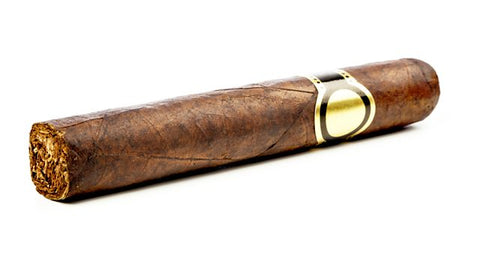
Although a handful of cigars are cut or twirled on both ends, the vast majority come with one straight cut end and the other capped with one or more small pieces of wrapper adhered with either a natural tobacco paste or with a mixture of flour and water. The cap end of a cigar must be cut or pierced for the cigar smoke to be drawn properly.
The basic types of cigar cutter include:
Guillotine (straight cut)
Punch
V-cut (a.k.a. notch cut, cat's eye, wedge cut, English cut)
Grip cutters
Cigar Scissors
Lighting
The head, or cap, of the cigar is usually the end closest to the cigar band, the other the "foot". The band identifies the type of the cigar and may be removed or left on. The smoker cuts or pierces the cap before lighting.
The cigar should be rotated during lighting to achieve an even burn while slowly drawn with gentle puffs. If a match is used it should be allowed to burn past its head before being put to the cigar, to avoid imparting unwelcome flavors or chemicals to the smoke. Many specialized gas and fluid lighters are made for lighting cigars. The tip of the cigar should minimally touch any flame, with special care used with torch lighters to avoid charring the tobacco leaves.
A third and most traditional way to light a cigar is to use a splinter of cedar known as a spill, which is lit separately before using.The thin cedar wrapping from cigars with one may be used.
Flavor
Each brand and type of cigar has its unique taste. Whether a cigar is mild, medium, or full bodied does not correlate with quality.
Among the factors which contribute to the scent and flavor of cigar smoke are tobacco types and qualities used for filler, binder, and wrapper, age and aging method, humidity, production techniques (handmade vs. machine-made), and added flavors. Among wrappers, darker tend to produce a sweetness, while lighter usually have a "drier", more neutral taste.
Evaluating the flavor of cigars is in some respects similar to wine-tasting. Journals are available for recording personal ratings, description of flavors observed, sizes, brands, etc. Some words used to describe cigar flavor and texture include; spicy, peppery (red or black), sweet, harsh, burnt, green, earthy, woody, cocoa, chestnut, roasted, aged, nutty, creamy, cedar, oak, chewy, fruity, and leathery.
Humidors
The level of humidity in which cigars are kept has a significant effect on their taste and evenness of burn. It is believed that a cigar's flavor best evolves when stored at a relative humidity similar to where the tobacco is grown, and in most cases, the cigars rolled, of approximately 65–70% and a temperature of 18 °C (64 °F).[dubious – discuss] Dry cigars become fragile and burn faster while damp cigars burn unevenly and take on a heavy acidic flavor. Humidors are used to maintain an even humidity level. Without one, cigars will lose moisture and acquire the ambient humidity within 2 to 3 days. A humidor's interior lining is typically constructed with three types of wood: Spanish cedar, American (or Canadian) red cedar, and Honduran mahogany. Other materials used for making or lining a humidor are acrylic, tin (mainly seen in older early humidors) and copper, used widely in the 1920s–1950s.
Most humidors come with a plastic or metal case with a sponge that works as the humidifier, although most recent versions are of polymer acryl. The latter are filled only with distilled water; the former may use a solution of propylene glycol and distilled water. Humidifiers, and the cigars within them, may become contaminated with bacteria if they are kept too moist. New technologies employing plastic beads or gels which stabilize humidity are becoming widely available.
A new humidor requires seasoning, after which a constant humidity must be maintained. The thicker the cedar lining the better. Many humidors contain an analog or digital hygrometer to aid in maintaining a desired humidity level. There are three types of analog: metal spring, natural hair, and synthetic hair.
In recent times Electric Humidors, which feature a thermoelectric humidification system have become popular for larger cigar collections.
Accessories
A wide variety of cigar accessories are available, in varying qualities.
Travel case
Travel cases protect cigars from direct exposure to the elements and minimize potential damage. Most come in expandable or sturdy leather, although metal leather and plastic lined cases are found. Some feature cardboard or metal tubes for additional protection.
Tube
Cigar tubes are used to carry small numbers of cigars, typically one or five, referred to by their number of "fingers". They are usually made from stainless steel, and used for short durations. For longer, a built in humidifier and hygrometer is used.
Ashtray
Ashtrays are used for collecting the ash produced by the cigar. Such ashtrays are typically larger than those used for cigarette smoking.
Holder
A cigar holder stood on end
A cigar holder is small tube in which the end of the cigar is held while smoked, to protect the hand from acquiring the odor of a burning cigar, historically used by women (for cigarettes as well). A cigar stand is a device used to keep a lit cigar out of an ashtray.

